The Internal, External, and Eternal

“Does it have no end, or no beginning? Or both?”
- the mathematician
1. Self Space and Time
Three months ago I was out with a dancer friend in New York. She was in town for a dancing in space conference, called Space Camp. They had invited a bunch of dancers and other interested people to the trampoline park in Long Island City, where they could jump around on the trampolines and also get into a zero-G freefall chamber to experience weightlessness. I thought the whole thing sounded gimmicky but probably that made it easier to fund. That was my first reaction. Anything to do with space is obviously suspicious.
Then she told me about the discussion they had that day. The teacher was talking about the difference between the internal, the external and the eternal. It’s hard to convey how much that hit me. It put into words, and not just words, a neat tripartite framing, something which has been haunting me for a long time, the essential conflict between the truth of the internal and the truth of the external. It highlighted the gap between being, the performance of being, and gestureed at a way beyond. In dance and in life.
In the dance sense: People start to dance because they love how it feels. Then as they get better at it and move towards performance settings, that is, dancing for others, for an external gaze, for a video, for a show, it becomes important to also start thinking about how they look, whether their angles are working, whether their position in the room relative to others makes sense, whether they are using the space well. It’s important to be aware of these things, so that the performance produces the right effect, even as it continues to be important to feel good, for the audience to feel good while watching.
Our feelings are internal, and the performance introduces a division, where the internal must interact with and present something for the external. The internal must re-organize itself into a production to be consumed by the external. For a lot of dance forms, this is the point. Ballet is to be done by angles. Street dance is at its peak in battle, within a circle of shouting viewers. But there’s a reason we started dancing in the first place, and it wasn’t for the viewers.
There are dance forms which aren’t for the viewers. Contact improvisation is generally not for the viewers. Solo dancing in the woods somewhere is not for the viewers. But these tend to lack excellence. They’re not “good” because they’re not meant to be good, they’re simply meant to be enjoyed.
When I heard Eternal, I thought -
There are things the performer is thinking, which are not communicated to the audience, but those thoughts are still important in the eternal sense, because they guide the action. So not everything is for the audience, not everything has to be for the audience. Important things can remain hidden. Instead of thinking we have to perform for the outside view, which flattens us, we perform for something else.
And then the dancer friend and I ran around in circles on a leftover dance floor which had been emptied post some girly pop show. The musicians were packing up, the fans were all lined up by the bar waiting for the singer to come our, and we were irreverently dancing, no show required.
Ever since that night I’ve been thinking of how to define it. Eternal.
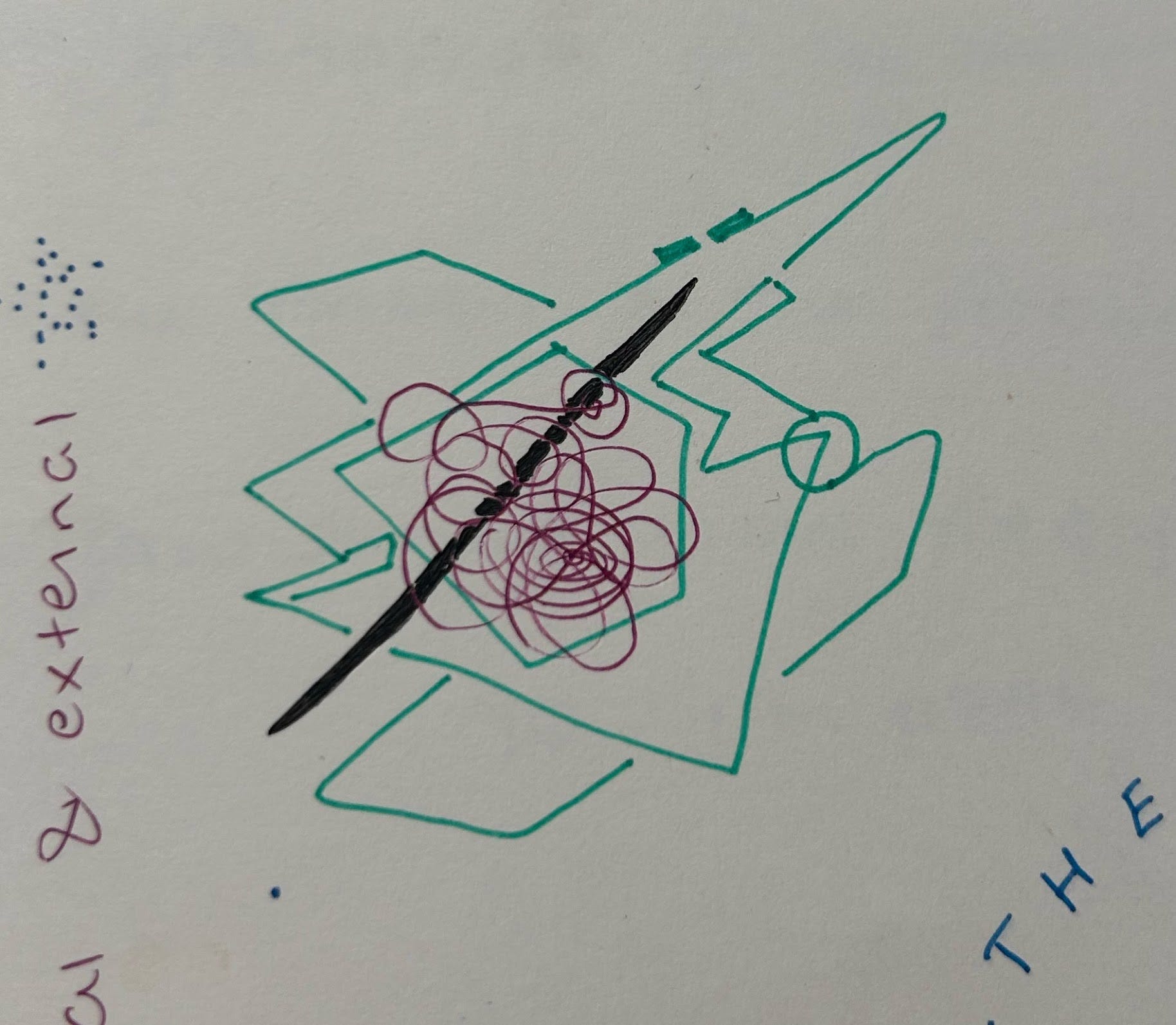
In a fit of creative inspiration from the dreamer, I started off trying to sketch it.
2. The Indescribable Third Thing
I told the above section, approximately, verbally and in person to a coworker of mine, who recently finished her MFA in Fiction. She said it reminded her of the Indescribable Third Thing. As part of her semester writing workshop, the class generally commented on three levels for when evaluating a short story. There was the line-level, which deals with rhythm, fluency of diction, word choice, tone, and other sentence-level things. There was the plot level of the story, which dealt with the larger moving parts of character, tension, and conflict. And there was the divine. The indescribable third thing.
It was so unfair, but during the workshop, people would sometimes say that a story worked on the line level and on the plot level, but it lacked the indescribable third thing.
We laughed. It was arbitrary, it was perfect.
Later I came up with some hypotheses for what the indescribable third thing could be:
1. Propulsiveness, or compulsion to keep reading. Propulsiveness is technique, it can be practiced and refined.
2. Visceral sensation - the displacement / jerk / yoink of being pulled into staring out at the world through someone else’s eyes
3. Sublingual mesmerization that comes through in between the lines from the rhythm of listening to a real voice.
The divine in writing did not have to be the same as the eternal in dance, but there seemed to be a link.
“I have a negative fourth option - the reader recognizes themself, and thinks that that recognition is divine but it’s actually just egotistical; thinking that your way to see the world is the way the world is”
- the writer
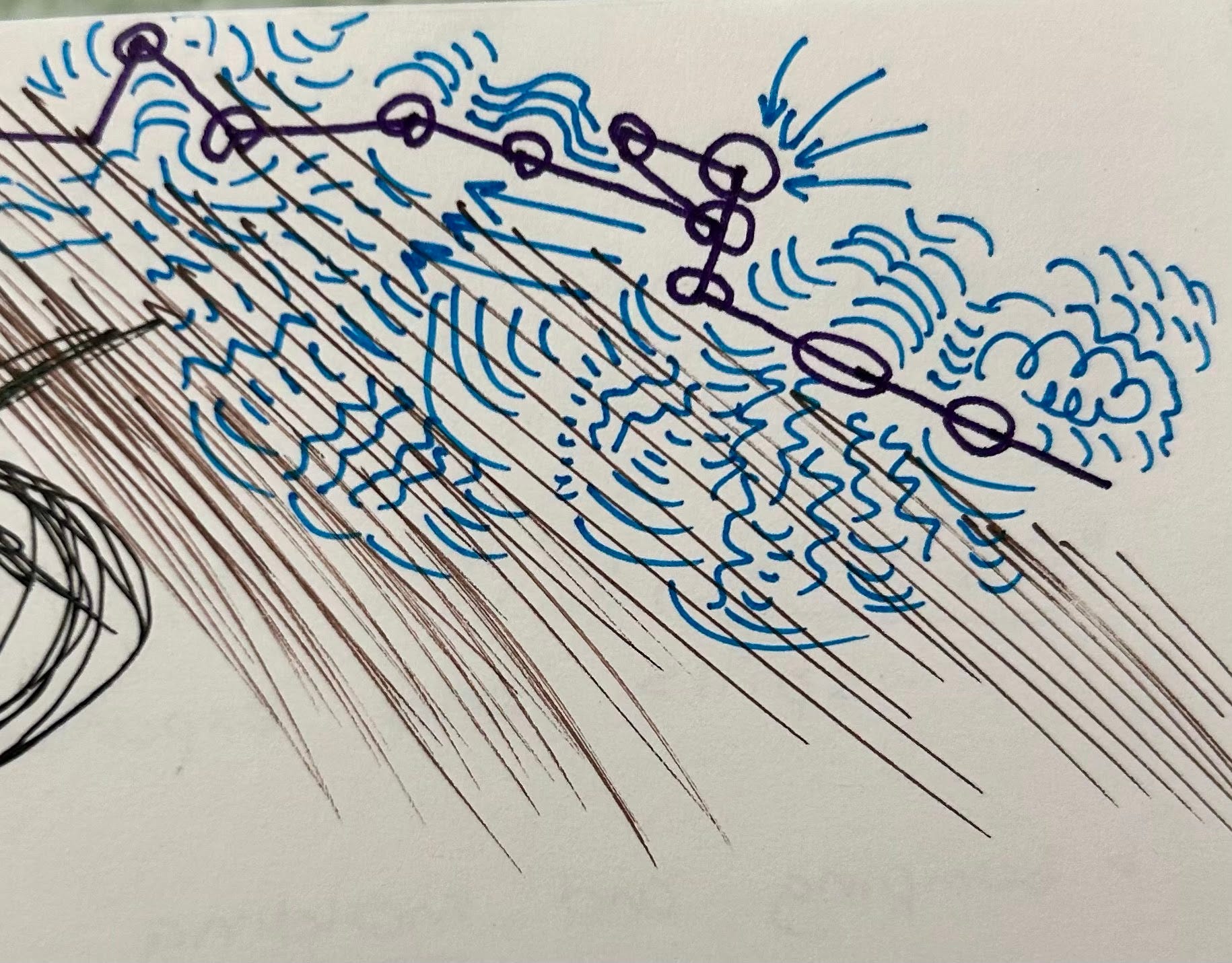
I asked the writer to sketch the internal/external/eternal as well.
3. From Dance to Life
In life: we start life with the internal.
As children we are consumed by our energy, and although we can be sleepy or sullen, we are pretty much completely free to feel our feelings very deeply. We dart around consumed within stories. The world holds deep mysteries. Society and government are inexplicable, every field bordering the woods is potentially endless, and the adults towering above are in a very different, slower, patterned universe.
At puberty we become aware of the External. The social mind blossoms, and in blossoming, quickly burdens us. Other people are here with us. Other people are looking (!) at (!) us (!) - that new, prickly feeling on the skin. Other people are similar to us, thinking like us, perceiving us, judging and evaluating us, and this new awareness makes us self-conscious.
When we become self-conscious, the self becomes aware that there is an external world that can laugh, mock, judge, or abstain from future contact. Then the values and opinions of that external world take primacy over our internal world, and it becomes hard not to become performative for that external world. But to be performative means giving up one’s freedom in exchange for the sense of acceptance. IT is shallow love.
Unself-conscious people are wonderful and arresting to observe, because pure emotions have transmissive power. Other people watching will catch them and feel them too. But as much as we might want to be rid of it, self-consciousness is hard to dislodge.
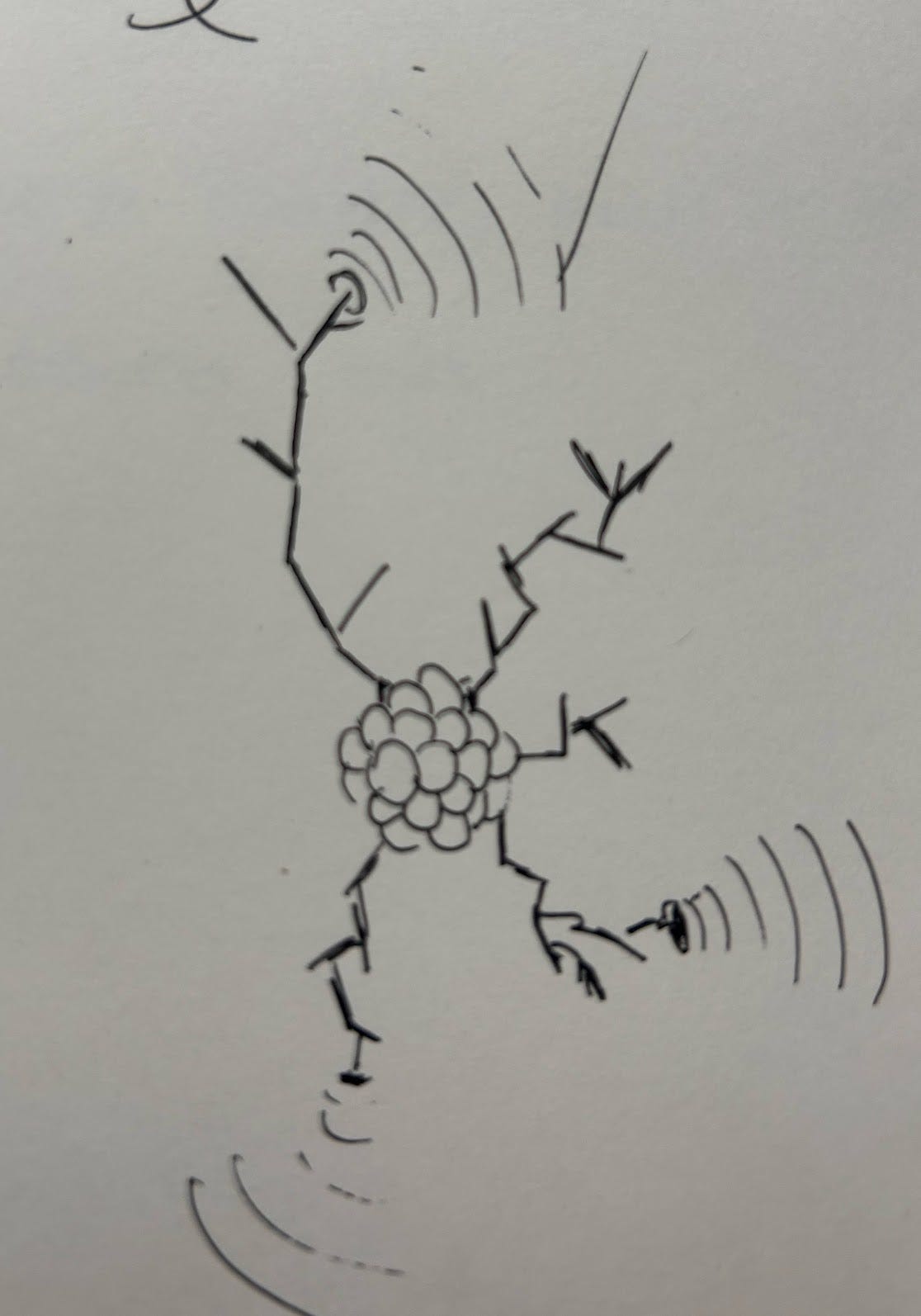
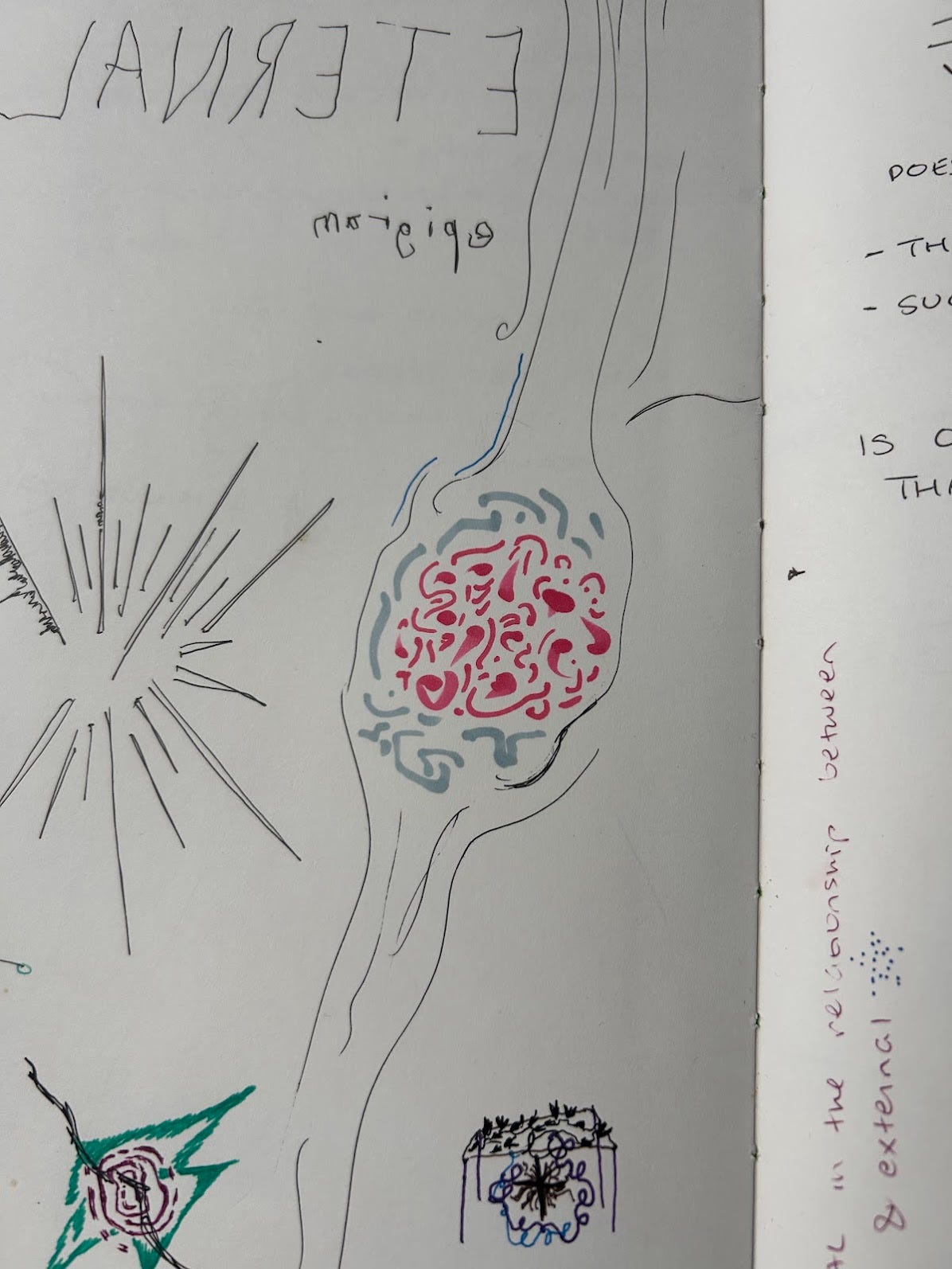
I asked several other people I know to sketch internal/external/eternal.
4. The Arrival of Narrative
There is also the Story of the Situation, or narrative consciousness, which seems to arrive at some point in the 20s.
Narrative, or reality-consciousness, is the realization that each internal/external situation is meaningless in and of itself, but acquires meaning through placing each situation as frames in a sequence, into narrative. There’s a particularly acute version of this active during interpersonal situations (the social reality), but it’s also meaningful when we’re alone. The Self likes to be locked in story.
Narrative-consciousness brings about the desire for self-definition, to understand what we are and to define it. This becomes a source of internal conflict when the definitions are in contrast with the emergent energy of self. The External is also obviously a constant source of conflict (because Hell is Other People) and so then we end up spending much time struggling about in the gray fog of undefinition, being buffeted by the slightest hint of narrative winds, fatefully torn atwixt crossroads and all that. Who are we? Why isn’t there an easy answer?
Enter the Eternal.
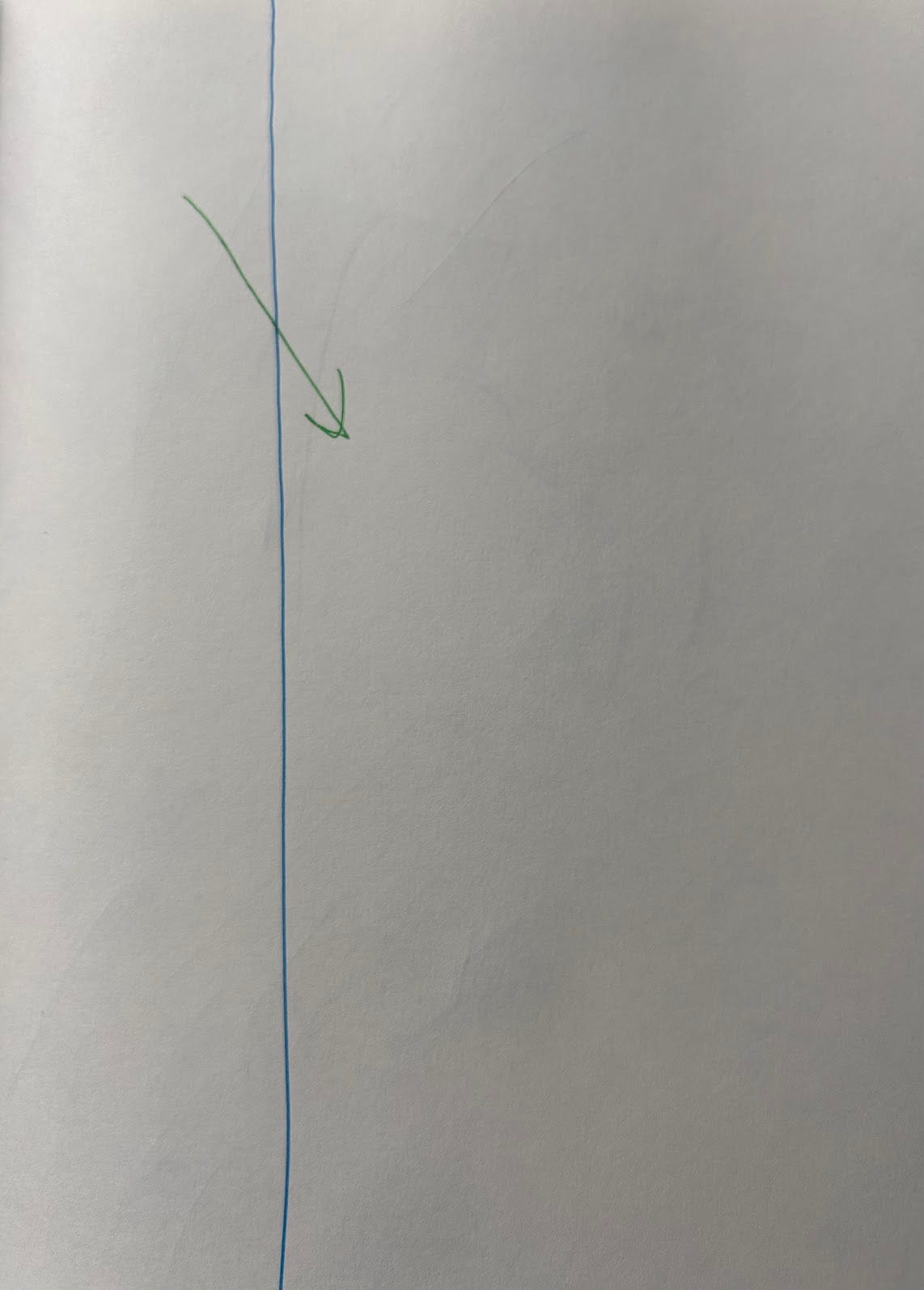
A Mondrian-inspired internal.external.eternal
5. The Temporary and the Divine
“Eternal alignment ensures that our temporary actions reflect God’s eternal truth, and it helps us live in a way that honors God both inwardly and outwardly” - random Internet website, basically accurate
You knew this essay would end up at God.
The Eternal exists in mystery. The Eternal is liminal and transcendent. The Eternal speaks all languages and has been to all countries and cares equally about all of them. The Eternal is here. The Eternal is happy.
The internal and external are inherently at odds. You can either listen to yourself or listen to the situation, the two are in tension. It is better to be part of something, as ourselves, while holding the judgement of the External at bay, because we have in our hearts an understanding of the Eternal.
There are spirituality-free ways to think about the Eternal. The Eternal is a perspective upon reality, an attitude bundled with a set of guiding values, the abstract concepts that we find the most important, like; fairness, freedom, community, originality, harmony, authenticity, satisfaction, excellence. Yet more than an attitude, it is the suffusion of a feeling, and a being-ness.
The Eternal understands what is real, and what is right. There is no need to fight a struggle that does not exist. When a struggle does exist - because struggles still happen, and they happen when something is at stake - we use our emotional sensitivity and our values to navigate through it. We can still get riled up in Eternal-land, just as we can still become self-conscious after we’re aware of narrative impermanence, because emotions aren’t our problem, they’re our signals for salience and what’s meaningful to us. We must not torch them. But we know what is real, and that provides solidity.
Nowadays I ask myself more often: “What am I trying to do here? Why? Really?”
Find church, find the divine, find yourself, it’s all one thing. Well, not really. I don’t mean to congeal worship with self-acceptance. But they do seem to be related.
The link between the Eternal in life and the Eternal in dance is that in both senses they are a personal secret with cosmic significance. Why do they have to remain a secret? Because you can’t explain your values to the end. You can only live them.
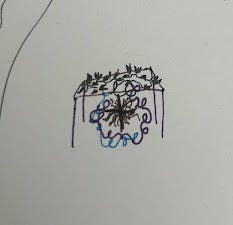
An internal/external/eternal ft. the Judaic chuppah
6. Values Are Kind Of Boring
Why don’t we just let our impulses pull us around unburdened by analysis? Is our happiness really contingent on this understanding, a conscious understanding of motivation?
The super happy don’t need to think about this. If you’re not a member of that elite set, then maybe it’s worth considering – maybe there’s another way to live. And more precisely, let us ask —
How can we lose our compunctions and our false burdens to become streamlined arrows towards the inherent values that we seek to embody? How do we burn away the shells between our pure energy and the world?
In part, it just happens over time. As we move through adulthood we transition between the burgeoning awareness of the External, to the deep awareness and likely resentment of the External, to the easy peace of the Eternal.
7. Car Metaphor
As children we’re essentially passengers through the world of action. Reactive, and held, or contained within family/friend group structures. We can affect the external world; if we get upset, or angry, but we can’t take serious action in the external world, because we don’t yet have a concept of what the external world is.
As adults, we can be more than just passengers. We can be the cars, becoming the engines of structure, drive, and desire for things to happen. We can move passengers around. And as we get to later adulthood, having seen many makes and models of cars, we develop our senses of steering and direction.
The passenger, car and driver, all three are important roles. The passenger doesn’t have to do anything to be the reason that the car and driver are acting together. In fact the car and driver exist in order to provide for a passenger. This multigenerational structure shows up in a lot of effective groups. Without guidance, people don’t feel grounded enough to start taking action. Without the engine, nothing gets done. And without a soul, there is no will to try.
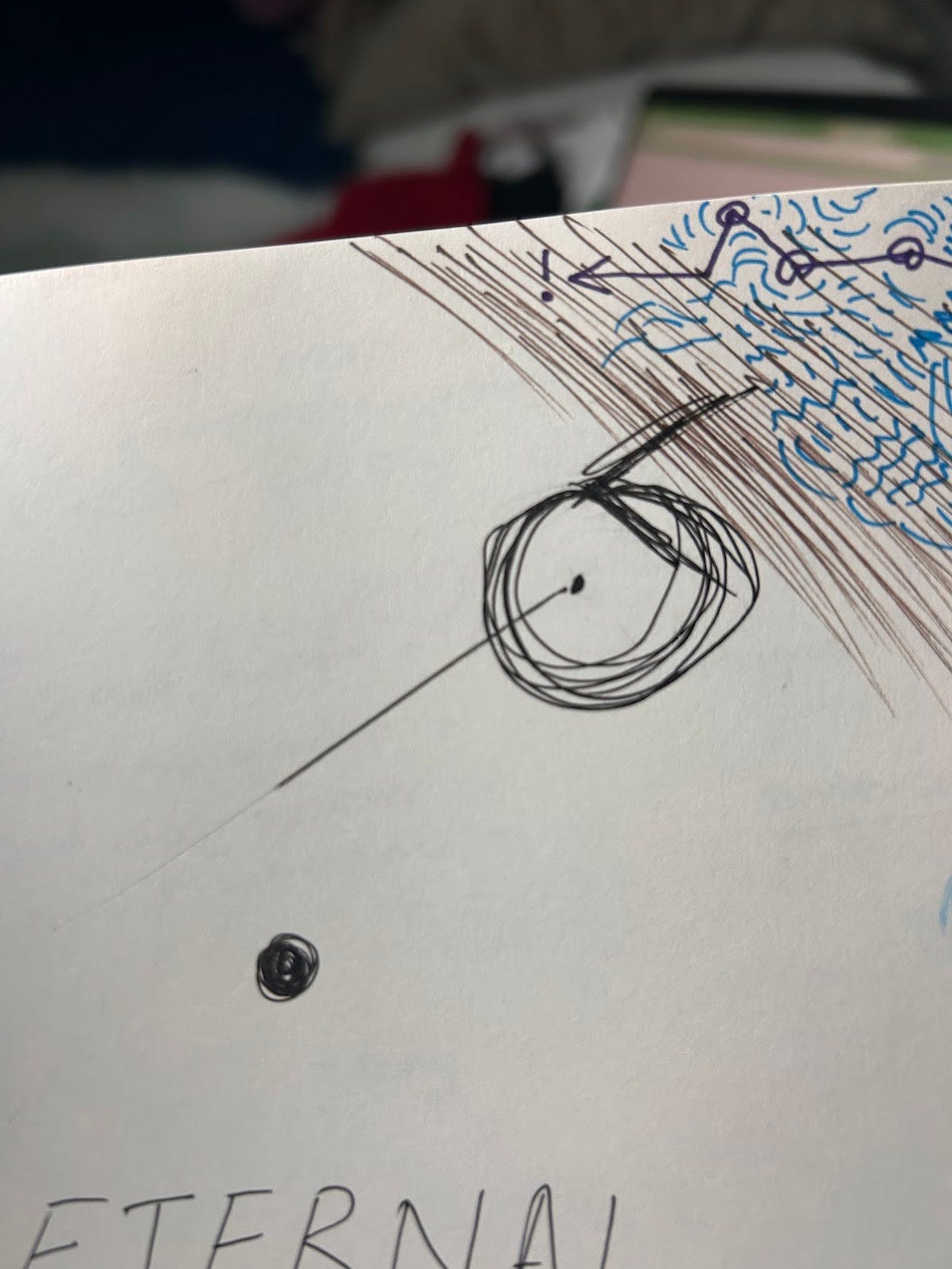
the bellybutton-ouroborous, a piercing cycle
super interesting framework! particularly drawn to how it relates to writing and discussing others' writing, but also the broader implications are interesting