Meditation
On silence, suffering, and Jungian alchemy

Over the New Years I went on a silent meditation retreat in Marin county, Northern California. Six days of vipassanā, with additional arrival and departure days. The rules were as follows:
We were not allowed to speak. We were not allowed to make eye contact. We would refrain from passing notes or otherwise attempting to communicate with each other. We could talk to our teachers in short one on one sessions on the second and fourth day, but other than that, for six days we were to remain in silence, walking, eating, sitting, and lying down to sleep in silence. We were not even supposed to remain alone with our thoughts, ponder our New Years resolutions or our event schedule upon returning home, because the goal of vipassanā is to gain control over the mind by clearing it.
Vipassanā, or insight meditation, is perhaps best known as a part of Buddhist spiritual tradition, but it actually predates the enlightenment of Siddhartha Gautama Buddha c. 500 BC. Insight meditation is a surprisingly structured practice, surprising at least to me who knew meditation superficially as the practice of clearing your mind as opposed to a theory on how to make sense of existence plus several practices on being in your body, being aware of your feelings and perceptions, and using all of these together to clear your mind. The breathing techniques in vipassanā predate the Buddha, and were used by him to attain enlightenment. Once attaining enlightenment, he outlined a more complete theory, the Eightfold Path, which is what Buddhists and students of meditation all around the world use to reach their own spiritual heights.
I arrive at the retreat on a Wednesday evening. There are two large meditation halls, a few smaller dormitories for housing, a dining hall, a few assorted yurts and huts, and then acres of hiking in the woods. The campus is in a small side-valley, and right above us loom the piney hills. There are a few hours before we enter into silence together, and so we can get to know the other retreat participants. The age range skews older, with the median age around 45, but there is a range of younger and older participants. I start up a conversation with a woman around my age. I tell her I’ve come to the retreat to train my mind to focus. She tells me she was put onto Buddhism by her psychiatrist after her divorce. After talking to a few other people, there is a common thread of pain. Death in the family, body image issues, flailing in life in the late thirties. Not everyone is in pain, but it seems many people came to Buddhism in a moment of grief.
At dinner, I sit with a high school teacher and a college instructor. They’ve both been on several retreats before, and they speak slowly. Very, very slowly. A measured, careful, warm, supportive, and slow speech. It’s part of the meditation practice, part of living mindfully, but also those who are grieving move slower. I feel a little bit like I am in a mental hospital. The college instructor tells a story about serving chai at a hippie festival in Oregon, and I crack a joke. Suddenly we’re all laughing and the conversation is moving at regular speed, and I feel like I’ve won at something, but also that I fucked with the rules of the game – it’s a good and bad feeling.
We clear away our plates and head up to the meditation hall after dinner, where our four teachers sit at the front of the room on four moderate chairs. The hall is big and beautiful, with about a hundred assorted seating cushions and chairs lined in rows, and an elaborate pyramidal ceiling covered in thin wooden slats with a top skylight perfect for beaming sacred energy down from the sky. This particular retreat center is on the cushy end – people have backrests, kneeling benches, six extra cushions to prop up their knees. I take one of the last floor cushions remaining, near the back.
Our teachers introduce themselves. There’s a man in his eighties, two women in their 40s/50s, and a man in his 40s. Slow voices, of course. The main thing notable about them is their faces – all wear the glossy mask of the blessed. Glowing smiles, wide eyes, a sense of clarity about them. Slow and steady motions, a lot of character in their voice. They are easy to look up to. Awakened ones. I decide to swallow my doubt about the efficacy of spiritual leaders so that I can dissolve into the retreat properly. The teachers tell us to introduce ourselves to our neighbors. To blend in with the mood, I feel like I ought to express my desire to be relieved of suffering. I want to have fun, I tell my neighbors. As in, I want to have fun again. Their eyes fill with puzzled concern. I’m pretty sure I failed to hit the right tone for that one. After that we go into silence for six days.
It makes sense that the retreat draws the grieving. After all, the final goal of the Eightfold Path is moksha, or the relief of suffering. So the people who come to the Path are suffering. I thought I had come to meditation to focus, but if I’m honest with myself, I’m suffering too. Thankfully the Buddha has answers for us.
Why does anyone suffer, if meditation is so effective? For one, although it’s easy to learn, it’s hard to follow, especially in moments of distress. The truth, in fact, the Truth of enlightenment, is that we can control how we respond to external circumstances. But, the practical truth, which the world constantly reminds us of, is that we can’t.
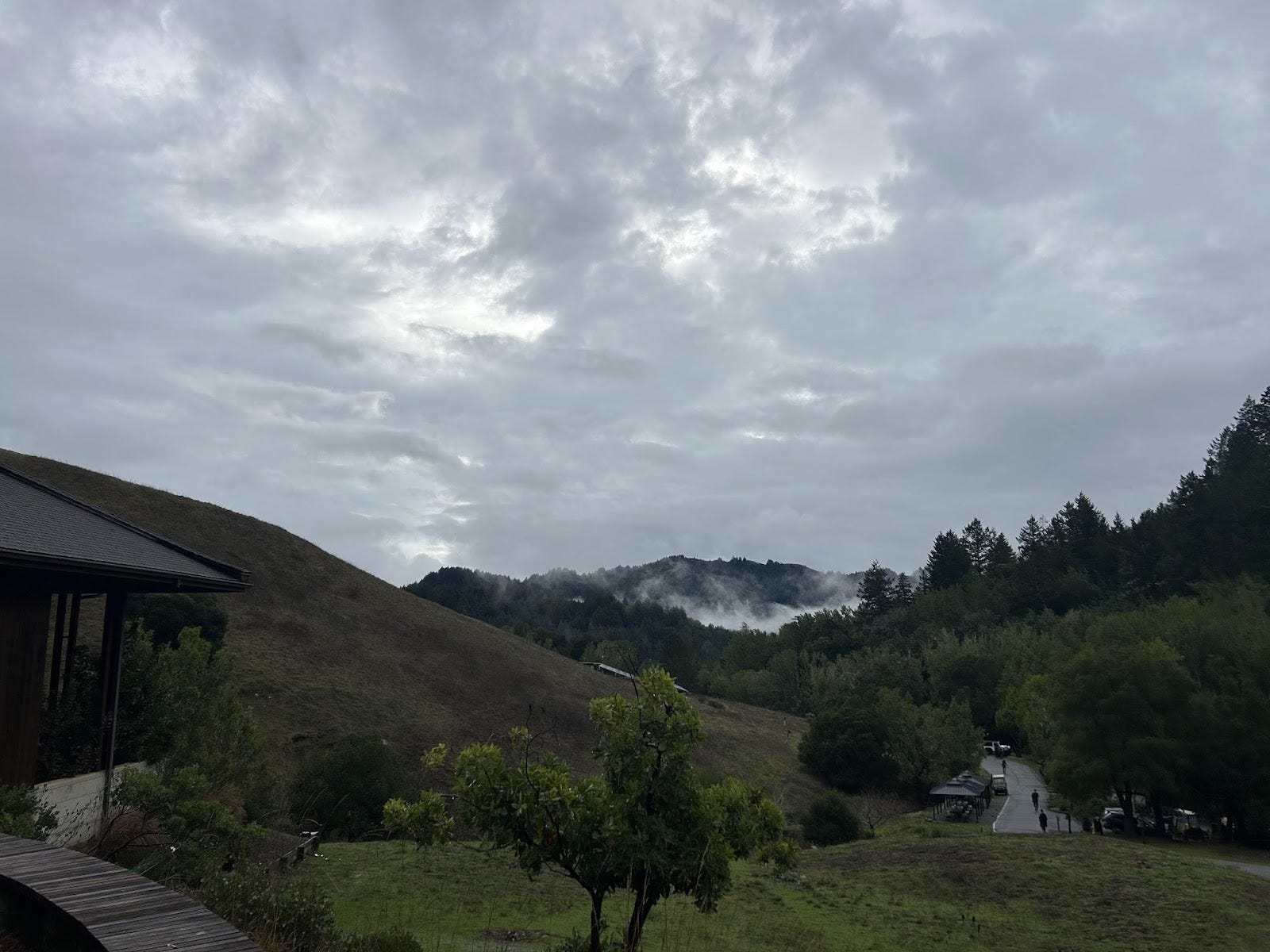
The air in Marin is cleaner. Every night a fog rolls in from the Pacific and lowers itself over the hills and valleys. Every morning the sun takes until midday to clear it away. The mornings are hazed in fog. The rain visits most mornings, washing the blue-green short grass and the dusky velvet tall grass. The air is always washed, always clean, with a slight bluish tinge from the grass and the deep bluegreen pines.
Our daily schedule is monastic. Wake-up is 530 AM. Thirty minutes sitting meditation before breakfast. There are three hours of mixed sitting and walking meditations before lunch, another three hours between lunch and dinner, and two hours after dinner, all the way up to bedtime. It’s unusual for a retreat schedule to not allot any individual free time. I mean, it’s just hard to keep people occupied for sixteen hours a day. It’s not like there’s anyone checking to make sure that we attend every meditation, and when I ask, the teachers are fine with us skipping meditations to hike, yet the overall tone is such that we are always part of the group. It’s a really nice feeling.
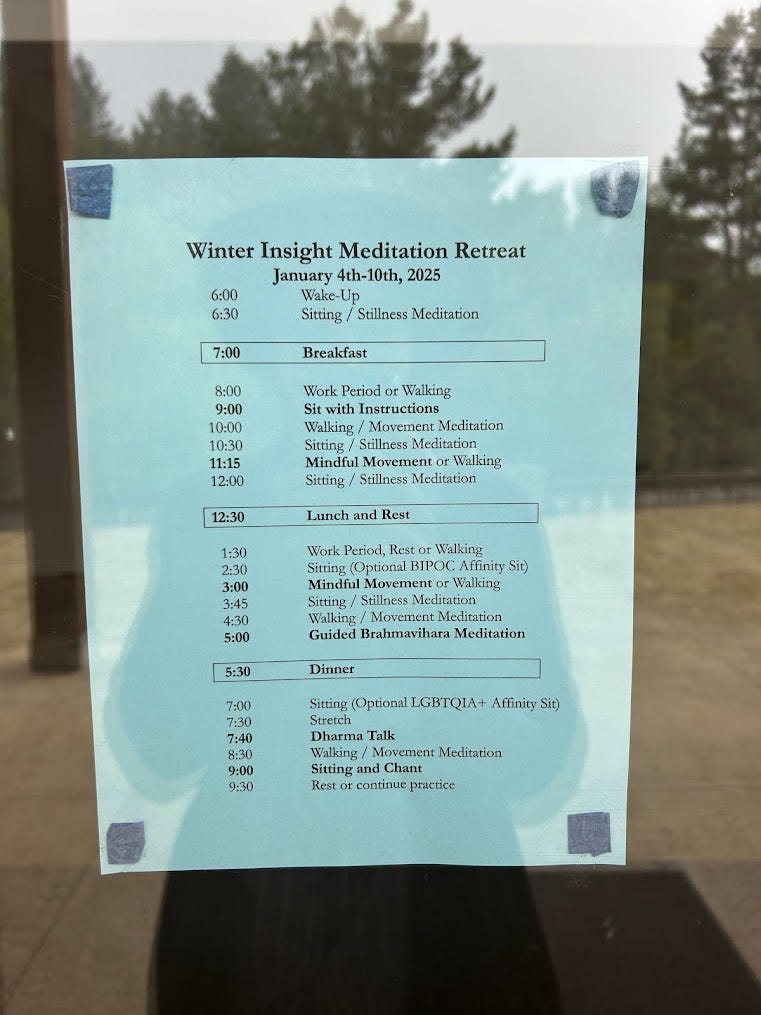
The schedule for the retreat right after ours. Very similar to our schedule, with small differences.
Not much happens for me on the first day. I attend all of the lectures and sits, and think about the given phrases, and study the people with better posture, but by the end of the day the novelty has worn off and I am desperately bored. Six days of this is alarming. I don’t plan to leave but then I don’t understand how the practice will change. Our teachers have been speaking in the language of alchemy: transformative change, metabolizing pain, dissolution and synthesis. Until fairly recently the California New Age vernacular used to aggravate me but in the place of those old sensitive receptors only a dull twinge emerges. I feel a new openness to the language, perhaps because I have grown more appreciation for how hard it is to communicate, and found a newfound love for transformation. California got to me.
In the evening we do our first walking meditation. All simple activities can be done as meditation. The Buddha ordained that sitting, walking, eating, talking, listening, standing and lying down were all important to study in the state of meditative focus. I learn – I really didn’t know much before coming here, so it’s easy to learn a lot – I learn that meditation is not simply about breathing and clearing the mind of thoughts. One must return to the body, that is, be aware of all tensions and sensations in the body, and it is through continuously returning to the sensations of the body that we become aware when we are having a negative reaction, that we are stressed. Then by addressing the sensation directly, by relaxing in the neck and shoulders, we can break the mental source of tension at the root.
This is a bonkers idea. I will just repeat it. If we can relax the body in a moment of stress and anxiety, it eases stress and anxiety mentally, even though nothing about the external situation actually changes. Meditative breathing works physiologically first: it reverses the tendency of anxious people to make shallow stressful breaths, and once the body is slowed down and cued into tranquil stillness, the thoughts tend to follow into tranquil stillness also.
Walking meditation is, as you might expect, very slow walking. The hundred-odd of us walk in staggered intervals along the path, thinking and breathing, and walking at 0.1x speed for forty-five minutes. I’m mesmerized by being part of a group in concentration. Walking together feels nutritious and hearty, as if I’m eating a big bowl of oatmeal. I want to commit to the bit, that this is the path for the relief of suffering.
In the morning of the second day, we go for small group meetings with the teachers. In this room, for about fifteen minutes each, we’re allowed to talk about how our practice is going. The only voices we’ve heard for the last day have been those of our teachers: deep, rich, serene, treasured. Ours by contrast are loopy and crackly-sharp from steaming with no outlet.
When I speak, I feel volcanic. I flush with heat so radiant that I start sweating and have to take off two layers of jackets. My thoughts have been rising in the silence, and they are of bad memories, all the petty slights, the half-forgotten procession of hauntings that follow me around in moments of low energy. I tell the group about my vengeances: half-buried memories of jealousy and envy, wayback anger that I’ve never gotten over.
Is it my imagination, or does the teacher lean away from me when I start speaking?
I am the last speaker and my voice is loud and throaty, and I feel myself making the subtle gestures of swagger. I know that I am the most confident person in this room, apart from the teacher, and that means I speak a touch louder than everyone else. It’s all subliminal, but I am aware of it, of the image that I am constructing as I speak. I don’t want to be aware of it. I wish I could forget.
I talk for my allotted time. I wonder what the others thought of it. The meeting ends, and we go back into silence.
In the evening one of the teachers talks about anger and metta, the practice of loving-kindness. The teacher talks about being with the anger, with metta, and showing love for yourself at the same time.
I think, I want to quench my love for suffering.
On the third day, it rains. When I head for the morning talk there are banana slugs on the road. They’re so big, banana slugs. Big, fat, and vulnerable to getting stomped by any careless passing foot. What if banana slugs had visibility vests with flags on top so that people can see them better. We could keep little crossing guard figurines that marked the passage of the banana slugs.
The teachers talk about the vedanās, the feeling-tones of perception, and then it is time for questions from the audience. It may seem, based on this post, that a lot of talking is going on, but remember these are the only things we (the students) got to say all day.
Someone asks, What do I do when the sound of breathing in this room makes me both happy and scared? COVID made these big gatherings so fraught.
A teacher responds: Notice your reactivity, and move towards your anchor.
Someone else asks: What do I do when I want to be with a thought, but I am both attracted and repulsed by it?
A teacher responds: Notice that the happiness and fear are in separate intervals of time.
I go for the longest hike on the property twice, once in each direction.
The college student has taken off her shoes to practice walking meditation on the road.
In the evening, there is a white egret who appears in the yard. He skulks, stealthy, if not for being bright white against the bluegreen grass, and a walking bird among people. His creepy S shaped neck coils up, and as he walks his neck wobbles strangely from left to right. He creeps along the bushes lining the path and about twenty people eventually are standing there watching him.
In the evening Dharma talk, the teachers talk about driving versus maps. The analogy is that meditation is like the skill of operating a car, but even with that, the driver needs a destination. The teacher says, We need to set an intention towards freedom. It’s okay if the intention is selfish.
After the Dharma talk is a sitting meditation. The air feels thick. The room is intensely still. I feel my restlessness crawling all over me, pushing me to move move somewhere nowhere I need to be. It shivers and shifts into a giant cockroach crawling over the room. It climbs up the front wall behind the teachers, six feet across and covered in a thick brass shell, its wings held in ready to abruptly launch forwards. It scuttle forwards and across, and then down the room towards me. Motionlessly I watch it approach. It raised onto its back legs to show a mess of pincers. It jumps up to the ceiling to burst into a shower of guts. I feel my body pierced by six hummingbirds which painlessly nestle in my torso and face. They flutter namelessly.
I am pleased when I go to sleep. The images feel like progress. They were neither wholly conscious nor wholly unconscious: just what appeared to me, and they felt right.
Jung had a theory of dreams. He said that dreams were the expression of the unconscious. The self is split into a conscious, waking part which thinks and feels in the ways which are familiar to us, and when that conscious part falls asleep, the other, unconscious part continues its work. The unconscious is made up of everything that the conscious mind rejects: all the things that it thinks are too bad and unseemly to be truly part of itself. While awake the conscious mind is successful at this repression, but in dreams the veil thins and these fearful things come through, garbed in symbolic representation. Part of the role of the psychologist is to help the patient understand what their unconscious is trying to express, without being too structuring and directive, or pulling out a manual of interpretation. What this might look like: If the patient has a dream where they are a mountain-climber who walks off the top of a mountain, the psychologist might ask “What does mountain-climbing mean to you?” and if the patient says “Achievement” the psychologist might then ask “Are you concerned about where your achievement might lead you?”.
Some people have very non-symbolic dreams and so the prospect of dream interpretation seems pretty dumb. I for whatever reason often have symbolic dreams, and so dream interpretation is a side door to the opaque fortress of conscious experience. It works, man.
Sleep is a process for defragmenting experience and consolidating the broad emotional arcs of the day. As in, when we sleep and wake up the next morning, we tend to make some kind of progress in whatever’s preoccupying us. We gain perspective and critical distance, without having done very much at all. The sixteen-odd hours of waking experience condense into memories, narrative, vedanās, and everything else that fills the Being. Dreams are a product of that distillation, though not everyone has them. And from what happened at the end of the retreat, I wonder whether meditation does something similar.
The fourth day is peaceful. By the fifth day, I’m craving a return to the outside world. I ask a question by note to one of the teachers – we are allowed to post covered notes on the wall if we have questions about the practice – I ask, why did the Buddha continue with his practice, how could the Buddha know that he was on the path to enlightenment? On the sixth day, the teachers announce that notes are banned.
“We cannot respond to …speculative questions on what the Buddha would say …if we met in the Safeway,” one says, slowly. He seems miffed.
We break our silence to do a short speaking meditation with our neighbors, to warm ourselves up for our re-entry to the world. My neighbor says, I saw you dancing with the egret. I actually saw you first, and I didn’t know what you were doing, and then I saw the egret walking, and you were copying its walk, and I thought, Ah, she’s having fun.
She remembered!
Everyone is moving faster after the speaking meditation. I have to get my phone back out of the technology lockbox to coordinate on pickups the next day, and when the little oblong enters my vision I can feel my attention pouring into it as if it were a piece of my body, like another face. I both loved my phone and I hated it; I was convinced that something very important was happening without me.
On the sixth night, it’s really hard to fall asleep. I lie awake for a while, then quietly do leg lifts on the floor of the room, trying to tire myself out from the weird electric feeling going through me. When I first got to this retreat I was a fast sleeper in my cozy twin bed. As the days passed, sleep has been harder and harder to catch, and each day the five-thirty am wakeup bell drags me out of more and more confusing dreams. After a long lifting session I crawl back into bed and have my wandering nighttime thoughts which at some threshold meld into unconsciousness.
Then, I am surrounded by sinking darkness and my body is paralyzing. The darkness has hands, and the hands are evil.
I wake up shouting.
It’s three am. Sorry, I had a nightmare, I whisper to my roommate. For some reason we’ve only talked in whispers while in this room. It’s alright, she whispers back. My body is on full alert. I grab a jacket and shuffle out into the cold.
After the nightmare, everything feels dangerous. Everything looks more alive: the trees, the buildings, the lamp light. Life is not simple, alive things can make their own decisions. The lamp light looks like it is on the verge of turning against me, but it does not.
I walk up into the hills, slowly, carefully. The walking paths are empty, and the hills are dark, and the darkness is full of malicious spirits. I don’t have a light, and it takes a few minutes for my eyes to adjust to the path. The hill skyline looms dark up above, and my ears pick up every cracking branch in the trees. At the first bump of the hill, as the lights of the buildings pass below the curve, I stop, facing the hill.
There are bobcats in the area, and the occasional mountain lion, and the lingering sense of danger, and the growing fear that I will not be able to sleep at all without going back to the nightmare.
It is quiet and cold. I am largely afraid, but there are a few insights which came to me in the last few days, and they come back to me now.
I grant you my life. I whisper it a few times to myself, and then head back down the hill.
After a few hours I try to sleep again, in one of the side buildings so I don’t wake anyone up if I’m restless. Nightmare. Danger. Guns. Coordinated attack. I wake up with my heart rushing and head straight to the emergency office phone. There is a 24/7 number to call for support. I am basically reaching for the handle when I hear the gong banging for the final morning meditation.
There is a style of speech that distinguishes long time meditators. Instead of saying “I feel tired” they say “a sensation of tiredness arises in me” and instead of saying “Hello” they say “I am noticing a desire to greet you”. I’m exaggerating but that’s the gist of it; they’re always using language to gesture at conscious awareness.
For the uninitiated however, it can come off a bit cultish. After the silence ends, people talk about how their parents and coworkers thought they had joined a cult. Back in Houston, back in Ohio, joining a silent meditation retreat for a week and coming back and talking about your inner peace was enough for coworkers to make you a bit of a standing joke. Our teachers talk about how they had switched from other careers to teach, and the resulting skepticism from their friends and family. One teacher, who was previously a prosecutor, had to go through not one, but two interventions.
Buddhism insists on a deep behavior change. From the outside, the refusal to react as usual can feel like withdrawal from the relationship, from the culture. But from the meditator’s standpoint, the withdrawal is to focus on the reality of the present moment, the actuality as opposed to the mental constructs that overlay it.
The next morning, I asked the hall how many people had nightmares or confused dreams during the week, and three-quarters of the room raised their hands. We are purifying the slurry of fragmented parts, one teacher said, with an exceptionally awakened look. I learned that my roommate crept out of bed at four am to look for me and make sure I was okay. She saw my jacket hanging in the meditation hall entrance and went back to sleep. She had already been kind of a bodhisattva in my head, walking around campus with a small curved smile and looking out at the stars. Some people are quite active at relieving suffering.
The nightmares were intriguing; I don’t usually have them, and they seem to be the direct result of six days of concentration. Something in the mind got shifted as a result of all of that integration and purification, and the dregs of whatever was left had to express itself while the conscious mind was out. Perhaps they are an internal resistance to change, or simply old shadows in the psyche which got unburied as part of the resettling. I really wonder what happened, it’s so reflexive that the only apparatus I have to measure it is the mind itself…